Tag Archive for: Removal

Trump’s Escalating Extreme Immigration Measures Towards Noncitizens in the Wake of the National Guard Member Shootings Will Not Make America Any Safer

In the wake of the tragic shooting of two National Guard members  on November 26, 2025, one of whom has succumbed, Trump uses her death as a pretext to go after millions  who had nothing to do with this attack. The alleged suspect, Rahmanullah Lakanwal,  was paroled into the US  from Afghanistan as part of Operation Allies Welcome. This program evacuated and resettled tens of thousands of vulnerable Afghans following the US military withdrawal and the Taliban takeover of the country.  Lakanwal applied for political asylum in 2024 and was granted asylum in 2025.  

Trump has now cast a shadow on not just Afghans who have come to the US, but on all immigrants including  lawful permanent residents and even people who have naturalized. One person’s actions do not at all justify the suspension of immigration benefits for all Afghan nationals and the imposition of draconian immigration restrictions. We should refrain from scapegoating and tainting an entire immigrant community even if Trump is indulging in it. This sort of racial profiling creates uncertainty and fear to Afghans who helped the US military at great risk to their lives. It also does a disservice to noncitizens who have immigrated and are  contributing to the US. 

Trump posted this on X in a late night screed on the eve of Thanksgiving:
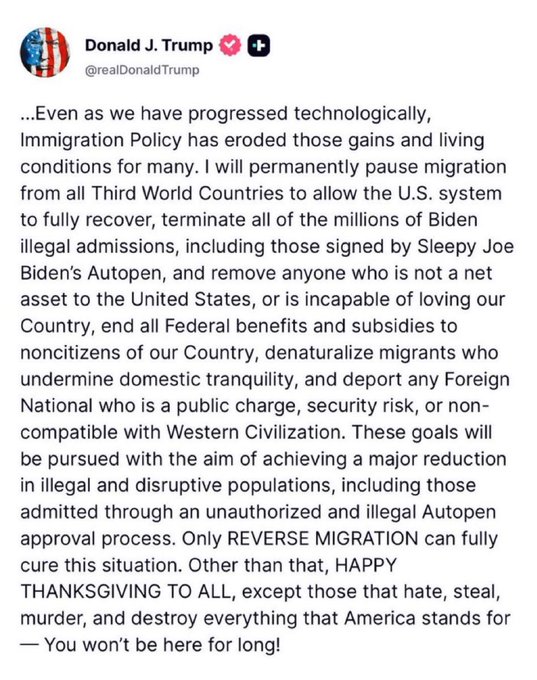
Image

Trump’s escalating immigration policies in the wake of the shooting include:

  • Pausing all asylum decisions
  • Stopped issuing visas to people from Afghanistan
  • Reviewing green cards issued to people from countries of concern
  • Threatening to end migration from third world countries and revoke citizenship from some naturalized citizens

The USCIS is using the countries that were included in the Presidential Proclamation of 6/10/2025 banning their nationals as negative factors when adjudicating benefits. The Proclamation was issued under INA 212(f) which speaks to the entry of aliens that would be detrimental to the interests of the United States. If USCIS relies on INA 212(f) to deny benefits to nationals of these countries who are already in the US, as opposed to those seeking entry into the US, it should not apply as these noncitizens are already in the US. The USCIS’s denial based on one’s country of nationality under the Proclamation could be challenged in court as an inappropriate reliance of INA 212(f). Although the USCIS has broad discretion in adjudicating immigration benefits such as adjustment of status applications, even a blatantly discriminatory policy as denying benefits solely based on one’s nationality might withstand a court challenge.  Unfortunately,  Congress has precluded challenges to denials of discretionary relief under INA 242(a)(2)(B). So, it may be difficult but not impossible  to challenge the USCIS policy as even discretionary denials cannot be blatantly discriminatory. 

We have pointed out in early March 2025 that Trump’s policies towards noncitizens were cruel and had no rational justification except to harass and intimidate noncitizens. Just prior to the shootings too,  the policy of  detaining spouses of US citizens who appear for their adjustment of status interviews at USCIS offices was the unkindest cut of them all. This has been happening at the USICS office in San Diego, and we hope it does not spread to other USCIS offices. The law allows the spouse of a US citizen, along with other immediate relatives of US citizens such as minor children and parents to adjust status in the US under INA 245(a). They are eligible for adjustment of status even if the underlying visitor status has expired. Most of the times the visitor status expires after the adjustment of status application has been filed and is processed at a glacial pace. This is beyond the applicant’s control. Now Trump’s  ICE agents with masks appear at an adjustment of status interview to detain the unsuspecting spouse who is all set to adjust status and become a permanent resident. The spouse would still become a permanent resident while in removal proceedings before an Immigration Judge, but what a colossal waste of taxpayer money and needless trauma for the family and kids. The only rationale behind this policy is to inflict cruelty, designed and implemented by either xenophobic or sadistic officials under Trump, or a combination of both, who have no sympathy or compassion towards people who are immigrating to the US legally under the INA and to unite with US citizens they love.

There has been a dark history in the US resulting in the scapegoating of immigrants in times of crisis.  A recent example was the restrictions imposed on noncitizens after the September 11, 2001 attack, which included the NSEERS program that resulted in religious, racial and ethnic profiling (see Have We Learned the Lessons of History? World War II Japanese Internment and Today’s Secret Detentions by Stanley Mark, Suzette Brooks Masters and Cyrus D. Mehta).  The delicate balance we strive to achieve as a nation between liberty and security inevitably tips towards security, and civil liberties tend to be compromised. While there can never be a justification to go after immigrants in a time of genuine crisis, Trump has manufactured a crisis to justify his administration’s wantonly cruel attacks on immigrants and now will use the shootings of the National Guard members to further restrict immigration.

The need of the hour is to advocate that one person’s bad acts should not taint all immigrants. Indeed, Lakanwal went through extreme vetting measures when they came to the US and applied for political asylum. Before his arrival, Lakanwal worked with the US government, including the CIA as a member of a partner force in Kandahar, Afghanistan, from 2011 until shortly after the US evacuation. Notwithstanding the extreme vetting measures he was subjected to, Lakanwal still shot at the National Guar members, which resulted in the senseless death of Sarah Beckstrom. It appears that Lakanwal got radicalized in the US and no amount of vetting may have prevented his entry into the US. The next shooter may well  be a homegrown American who probably has never stepped foot outside the US.  It is also worth pointing out that there was no need for Trump to place members of the National Guard in DC and other cities in the first place. 

Contrary to Trump’s unhinged post, we must remember that immigrants have played a crucial role in making America great, and restricting immigration based on isolated incidents will only rob the nation of their talents and contributions.

In conclusion, it is imperative that we resist the temptation to respond to tragedy with fear-driven policies. Instead, we should strive for solutions that uphold the values of liberty and justice, ensuring that America – a nation of immigrants – remains a beacon of hope and opportunity for all.


Personal Conflicts of Interest Arising Out of the Israel-Hamas War

By Cyrus D. Mehta and Kaitlyn Box*

The escalating war between Israel and Hamas  presents unique  challenges for immigration lawyers who represent noncitizens from impacted areas.

One such ethical conundrum arises when a lawyer comes to know that a current or prospective client holds views about the conflict that the lawyer strongly disagrees with or even finds repugnant. A lawyer whose family member was killed in the October 7th attack might not wish to represent a client who expresses support for Hamas, while a lawyer whose relative was killed or injured in the recent Israeli Defense Force (IDF) airstrikes in Gaza may not feel comfortable representing a former IDF soldier who expresses a lack of regret at the loss of lives of children and wants to apply for adjustment of status. Under some circumstances, a lawyer will have a personal conflict of interest if there is a significant risk that the lawyer’s professional judgment on behalf of the client will be adversely affected because of the opposing views between the lawyer and the client.

Because immigration lawyers are responsible for bringing in a client into the US or allowing the client to remain in the US, the personal conflict becomes more enhanced if they find the client’s views or conduct objectionable.

Pursuant to Model Rule 1.7(a)(2) of the American Bar Association (ABA), a lawyer shall not represent a client if a concurrent conflict of interest exists because “there is a significant risk that the representation of one or more clients will be materially limited by…a personal interest of the lawyer”. While the ABA provides model rules of professional responsibility, lawyers should refer to the analog of these rules in their own state bars that are binding on them.   Thus, a lawyer who feels uncomfortable representing a client due to the client’s views on the conflict need not do so, and can decline the representation. On the other hand, a lawyer need not shy away from representing a client, however objectionable the conduct may be, so long as there is a legal basis to represent the person.

If a lawyer realizes that a personal conflict of interest of this type exists with a current client, the lawyer can still withdraw from the representation of a client whose views or activities she finds reprehensible under ABA Model Rule 1.16(b)(4), which permits withdrawal if “the client insists upon taking action that the lawyer considers repugnant or with which the lawyer has a fundamental disagreement”. Alternatively, a lawyer may withdraw from representation under ABA Model Rule 1.16(b)(7) if “other good cause for withdrawal exists”, which could include a fundamental disagreement with a client’s stance on, or activities related to, the conflict.

In other circumstances, though a lawyer may wish to represent, or continue representing a client, even though a personal conflict exists. A lawyer who finds herself in this situation may seek a waiver of the conflict under ABA Model Rule 1.7(b), provided that “the lawyer reasonably believes that the lawyer will be able to provide competent and diligent representation to each affected client, the representation is not prohibited by law….”, and the client provides consent. For example, a lawyer who finds protests opposing Israel objectionable may be representing a foreign student in F-1 status who has vehemently protested against the Israeli invasion of Gaza without expressing any sympathy for the victims of the Hamas attack on October 7, 2023. If the student client was involved in a protest that resulted in a physical altercation with an opposing group of protestors, he could be charged with assault, potentially a removable offense under INA § 237(a)(2)(A)(i). The lawyer can inform the student that she finds the student’s conduct repugnant but may still be able to competently and diligently represent the student by advising his criminal defense lawyer to negotiate the assault charge to a disorderly conduct offense, which will likely not have deportation consequences. On the other hand, the lawyer can inform the client that she will not be able to justify the student’s conduct in a press briefing or interview on behalf of the client because she disagrees with his conduct and finds it repugnant. If the client agrees to this sort of limited representation, the lawyer can represent the client competently and diligently notwithstanding this limitation. However, if it is important for the lawyer to be available to defend the student’s actions in the media as that might get the client a better deal with the prosecutors, and the lawyer is unable to handle media interviews on behalf of the client, then this potentially creates a non-waivable conflict and the lawyer must withdraw.

Immigration lawyers may also find themselves representing noncitizen students in F-1 visa status who are facing other immigration-related consequences as a result being involved in protests or making statements about the conflict. University of Pennsylvania President Liz Magill recently resigned after appearing to evade a question asking whether students who called for a “genocide of Jews” should be punished. This episode demonstrates terminology can be misunderstood, and how easily it could potentially ensnare a foreign student in F-1 status. While the term ‘intifada’ could mean an ‘uprising’ or ‘shaking off’ (see here and here), it could also be understood as violent resistance tantamount to  “genocide”, as illustrated by the Congressional hearing before Congresswoman Stefanik during which Magill and other university presidents testified. As we explained in our prior blog, there is a potential for troubling consequences for a noncitizen leader of a student organization who speaks out about the conflict in a way that seems to endorse terrorist activity.  A student who is on an F-1 visa could be found inadmissible under INA § 212(a)(3)(B)(i)(IV)(bb) as a representatives of “a political, social, or other group that endorses or espouses terrorist activity”. INA 212(a)(3)(B)(v) defines “representative” as “an officer, official, or spokesman of an organization, and any person who directs, counsels, or induces an organization or its members to engage in terrorist activity”. INA 237(a)(4)(B) also renders a noncitizen who is described in INA §212(a)(3)(B) and INA § 212(a)(3)(D) removable. Similarly, INA § 212(a)(3)(B)(i)(I) renders inadmissible noncitizens who “have engaged in terrorist activity”, which can include commission of “an act that the actor knows, or reasonably should know, affords material support, including a safe house, transportation, communications, funds, transfer of funds or other material financial benefit, false documentation or identification, weapons (including chemical, biological, or radiological weapons), explosives, or training” to a terrorist organization. If a student who has been ensnared under these provisions seeks the assistance of an immigration lawyer, the lawyer must first examine whether they would be able to objectively represent this individual. An attorney who has relatives still being held hostage by Hamas, must evaluate whether his objectivity in representing the client would be compromised under ABA Model Rule 1.7(a)(2).

Immigration lawyers should also be aware that not all personal conflicts can be waived. If the representation will result in a clear violation of the rules of professional conduct or other law, ABA Model Rule 1.16(a)(1) obliges the lawyer to withdraw. Regardless of whether a lawyer wishes to withdraw from representation under ABA Model Rule 1.16, or is required to do so, the lawyer must seek the permission of the tribunal to withdraw when the matter is before the tribunal. Moreover,  upon termination of representation the lawyer must take all reasonable steps to protect the client’s interest including giving reasonable notice, allowing time for the client to retain another counsel, surrendering papers and property to which the client is entitled to and refunding any unearned fees.

In screening for potential personal conflicts, immigration lawyers should be mindful of ABA Model Rule 8.4(g), which sanctions conduct that constitutes harassment or discrimination based on certain protected grounds related to the practice of law including race, sex, religion, national origin, ethnicity, disability. Age, sexual orientation, gender identity, marital status or socioeconomic status.

A lawyer who broadly declines to represent clients of a particular nationality or ethnicity, or applies additional screening procedures to only these clients, faces the risk of being sanctioned under Rule 8.4(g). Lawyers who engage in discriminatory conduct can also be sanctioned under the state analogs to Rule 8.4(g). Rule 8.4(h) of New York’s Rules of Professional Conduct, for example, broadly allows for the discipline of a lawyer who “engage[s] in any other conduct that adversely reflects on the lawyer’s fitness as a lawyer”. A New York lawyer who threatened to report restaurant employees who were speaking Spanish to ICE in 2018 was censured under NY Rule 8.4(h).


*Kaitlyn Box is a Senior Associate at Cyrus D. Mehta & Partners PLLC.


F-1 Cap Gap Students In Limbo From October 1, 2018 Onward If Their H-1B Cases Have Not Been Approved

It is October 1, 2018 and this morning, in what is an extremely unfortunate yet totally preventable situation, businesses across the U.S. were forced to temporarily terminate the employment of F-1 students who were previously employed pursuant to their cap-gap extension period.

Briefly, the cap-gap extension regulation temporarily extends the OPT (Optional Practical Training) period for F-1 students with pending H-1B petitions and requests for change of status. The cap-gap period starts when an F-1 student’s status and work authorization expire, and they are extended through September 30th, the end of fiscal year. The ongoing suspension of USCIS’ premium processing service, previously discussed in one of our earlier blogs, has critically impacted H-1B cap subject petitions for F-1 students in the cap-gap extension period. USCIS has found a way to basically suffocate the H-1B visa program.

USCIS extended the suspension of premium processing for fiscal year 2019 cap-subject H-1B petitions which was originally slated to last until September 10, 2018, through to an estimated date of February, 19, 2019. USCIS’ premium processing service has always been a heavily utilized option for U.S. businesses providing them with a significantly faster adjudication timeline of a few weeks instead of the regular processing time of 6-9 months! The premium processing option also allowed businesses to ensure that their professional staff would be available to meet critical project timelines and thus allowed them to plan accordingly. Employers had to offer the jobs prior to April 1, and then file H-1B petitions on behalf of the foreign national within the first five days of April 2018 to be considered in the H-1B visa lottery.  Under the H-1B regulations, an H-1B petition may not be filed or approved earlier than six months before the date of actual need for the beneficiary’s services or training. Therefore, U.S. employers are unable to file an H-1B petition on behalf of a prospective employee more than six months from the intended start date but the processing of that H-1B petition may take well beyond six months.  Without premium processing, many employers are left unable to hire the H-1B worker on October 1, 2018 even though the job offer was made more than six months ago and the petition is potentially approvable. In addition, premium processing was also a great tool for the F-1 student. Imagine having a petition filed on your behalf in the first week of April and for the next 6-9 months, or likely longer, being unable to make any concrete plans for your future, including not knowing whether you would be allowed to remain in the US or have to immediately pack your bags and leave.

USCIS stated that the suspension of premium processing is necessary in order to allow the agency to “[b]e responsive to petitions with time-sensitive start dates” but it is not clear why F-1 students who are in a cap-gap extension period failed to qualify as having time-sensitive start dates. U.S. employers forced to suspend the employment of these F-1 students have no recourse. USCIS has indicated that these petitioners may submit a request for expedited processing but the expedite process is grossly unreliable and it is not clear how these requests are being processed. It is by no means a viable alternative to premium processing.

As of October 1, F-1 students previously employed pursuant to a cap-gap extension are no longer authorized to work and will start accruing unlawful presence in the U.S. if they continue to work under the new unlawful presence policy applicable to students. However, the F-1 student generally may remain in the United States while the change of status petition is pending without accruing unlawful presence, provided they do not work without authorization. This student also cannot travel during the limbo period, unless he or she is prepared to return to the US after the H-1B petition is approved on a new H-1B visa. But one should not assume that the H-1B petition will get approved in a climate where the Trump administration is routinely challenging H-1B petitions for occupations that were previously easily approved.  Although the USCIS has at this time delayed its removal policy with respect to employment-based petitions that ultimately get denied, the delay will not be indefinite and these F-1 cap students will find themselves not just  accruing unlawful presence, but will also find themselves facing removal proceedings if the H-1B petition and the request for change of status is denied.

Of course, if an F-1 student with a pending change of status H-1B petition has work authorization (such as a valid Employment Authorization Document (EAD)) that extends past September 30th they may continue to work as authorized.

The American Immigration Lawyers Association (AILA) has called on USCIS to immediately lift the premium processing suspension on FY 2019 H-1B cap-subject petitions for beneficiaries who are in a cap-gap extension period, or alternatively, to publish a notice in the Federal Register extending the cap-gap work authorization period to at least 90 days beyond September 30, 2018, or until all FY 2019 H-1B cap cases can be adjudicated. To date USCIS has issued no response to this request.

In choosing to so suffocate the H-1B visa program, USCIS is restricting legal immigration and fulfilling the Trump administration’s objective under its “Buy American and Hire American” Executive Order No. 13788. But a negative chain reaction easily ensues with an immigration policy influenced by BAHA:  U.S. businesses cannot remain competitive if they are unable to hire the best students graduating from US universities, including foreign students in F-1 status.  U.S. universities will get hurt if they cannot attract the best students in the world who also pay full tuition fees. The U.S. loses out as a nation if it cannot compete with other countries for the best and brightest. The only way out of this downward spiral is for this administration to come to its senses and provide much needed oxygen to the H-1B program it has cruelly strangulated by restoring premium processing and adjudicating bona fide H-1B petitions more sensibly so that they get approved rather than denied.