Tag Archive for: Detention

Trump’s Escalating Extreme Immigration Measures Towards Noncitizens in the Wake of the National Guard Member Shootings Will Not Make America Any Safer

In the wake of the tragic shooting of two National Guard members  on November 26, 2025, one of whom has succumbed, Trump uses her death as a pretext to go after millions  who had nothing to do with this attack. The alleged suspect, Rahmanullah Lakanwal,  was paroled into the US  from Afghanistan as part of Operation Allies Welcome. This program evacuated and resettled tens of thousands of vulnerable Afghans following the US military withdrawal and the Taliban takeover of the country.  Lakanwal applied for political asylum in 2024 and was granted asylum in 2025.  

Trump has now cast a shadow on not just Afghans who have come to the US, but on all immigrants including  lawful permanent residents and even people who have naturalized. One person’s actions do not at all justify the suspension of immigration benefits for all Afghan nationals and the imposition of draconian immigration restrictions. We should refrain from scapegoating and tainting an entire immigrant community even if Trump is indulging in it. This sort of racial profiling creates uncertainty and fear to Afghans who helped the US military at great risk to their lives. It also does a disservice to noncitizens who have immigrated and are  contributing to the US. 

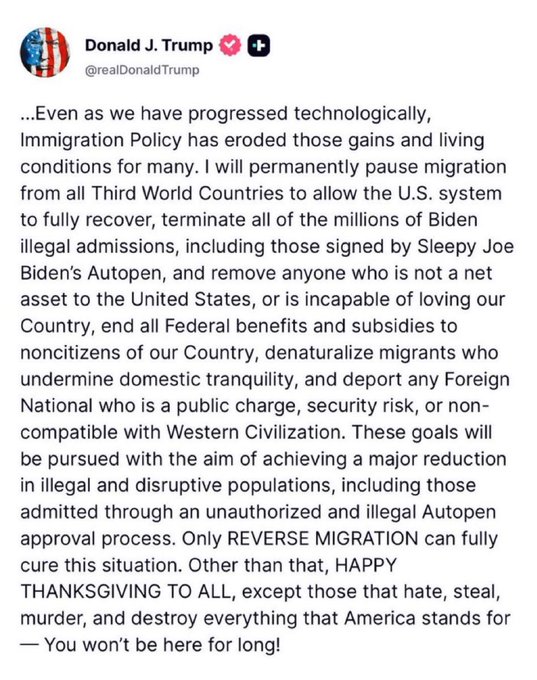
Trump posted this on X in a late night screed on the eve of Thanksgiving:

Image

Trump’s escalating immigration policies in the wake of the shooting include:

  • Pausing all asylum decisions
  • Stopped issuing visas to people from Afghanistan
  • Reviewing green cards issued to people from countries of concern
  • Threatening to end migration from third world countries and revoke citizenship from some naturalized citizens

The USCIS is using the countries that were included in the Presidential Proclamation of 6/10/2025 banning their nationals as negative factors when adjudicating benefits. The Proclamation was issued under INA 212(f) which speaks to the entry of aliens that would be detrimental to the interests of the United States. If USCIS relies on INA 212(f) to deny benefits to nationals of these countries who are already in the US, as opposed to those seeking entry into the US, it should not apply as these noncitizens are already in the US. The USCIS’s denial based on one’s country of nationality under the Proclamation could be challenged in court as an inappropriate reliance of INA 212(f). Although the USCIS has broad discretion in adjudicating immigration benefits such as adjustment of status applications, even a blatantly discriminatory policy as denying benefits solely based on one’s nationality might withstand a court challenge.  Unfortunately,  Congress has precluded challenges to denials of discretionary relief under INA 242(a)(2)(B). So, it may be difficult but not impossible  to challenge the USCIS policy as even discretionary denials cannot be blatantly discriminatory. 

We have pointed out in early March 2025 that Trump’s policies towards noncitizens were cruel and had no rational justification except to harass and intimidate noncitizens. Just prior to the shootings too,  the policy of  detaining spouses of US citizens who appear for their adjustment of status interviews at USCIS offices was the unkindest cut of them all. This has been happening at the USICS office in San Diego, and we hope it does not spread to other USCIS offices. The law allows the spouse of a US citizen, along with other immediate relatives of US citizens such as minor children and parents to adjust status in the US under INA 245(a). They are eligible for adjustment of status even if the underlying visitor status has expired. Most of the times the visitor status expires after the adjustment of status application has been filed and is processed at a glacial pace. This is beyond the applicant’s control. Now Trump’s  ICE agents with masks appear at an adjustment of status interview to detain the unsuspecting spouse who is all set to adjust status and become a permanent resident. The spouse would still become a permanent resident while in removal proceedings before an Immigration Judge, but what a colossal waste of taxpayer money and needless trauma for the family and kids. The only rationale behind this policy is to inflict cruelty, designed and implemented by either xenophobic or sadistic officials under Trump, or a combination of both, who have no sympathy or compassion towards people who are immigrating to the US legally under the INA and to unite with US citizens they love.

There has been a dark history in the US resulting in the scapegoating of immigrants in times of crisis.  A recent example was the restrictions imposed on noncitizens after the September 11, 2001 attack, which included the NSEERS program that resulted in religious, racial and ethnic profiling (see Have We Learned the Lessons of History? World War II Japanese Internment and Today’s Secret Detentions by Stanley Mark, Suzette Brooks Masters and Cyrus D. Mehta).  The delicate balance we strive to achieve as a nation between liberty and security inevitably tips towards security, and civil liberties tend to be compromised. While there can never be a justification to go after immigrants in a time of genuine crisis, Trump has manufactured a crisis to justify his administration’s wantonly cruel attacks on immigrants and now will use the shootings of the National Guard members to further restrict immigration.

The need of the hour is to advocate that one person’s bad acts should not taint all immigrants. Indeed, Lakanwal went through extreme vetting measures when they came to the US and applied for political asylum. Before his arrival, Lakanwal worked with the US government, including the CIA as a member of a partner force in Kandahar, Afghanistan, from 2011 until shortly after the US evacuation. Notwithstanding the extreme vetting measures he was subjected to, Lakanwal still shot at the National Guar members, which resulted in the senseless death of Sarah Beckstrom. It appears that Lakanwal got radicalized in the US and no amount of vetting may have prevented his entry into the US. The next shooter may well  be a homegrown American who probably has never stepped foot outside the US.  It is also worth pointing out that there was no need for Trump to place members of the National Guard in DC and other cities in the first place. 

Contrary to Trump’s unhinged post, we must remember that immigrants have played a crucial role in making America great, and restricting immigration based on isolated incidents will only rob the nation of their talents and contributions.

In conclusion, it is imperative that we resist the temptation to respond to tragedy with fear-driven policies. Instead, we should strive for solutions that uphold the values of liberty and justice, ensuring that America – a nation of immigrants – remains a beacon of hope and opportunity for all.

Impact of the Overturning of Roe v. Wade on Immigrants

By Cyrus D. Mehta, Kaitlyn Box*, and Jessica Paszko**

On June 24, 2022, the Supreme Court issued its opinion in Dobbs v. Jackson Women’s Health Organization, overturning the landmark decision Roe v. Wade, and holding that there is no constitutional right to an abortion. Justice Alito, writing for the majority, first held that abortion is not implicitly protected by any constitutional provision, including the Due Process Clause. The opinion further states that although the Due Process Clause protects some rights that are not specifically enumerated in the Constitution, those rights must be “deeply rooted in this Nation’s history and tradition” and “implicit in the concept of ordered liberty.” Because abortion was not a recognized legal right until the latter half of the 20th century, according to the majority, and was until then often punishable as a criminal offense, the court reasons that it cannot fall into the category of activities protected by the Due Process Clause. The opinion also addresses whether the right to obtain an abortion “part of a broader entrenched right that is supported by other precedents”. The Court concludes that overturning Roe would not upset other precedential decisions that involve fundamental rights not specifically mentioned in the Constitution, like Griswold v. Connecticut (contraception), Obergefell v. Hodges (same-sex marriage), and Lawrence v. Texas (same-sex sexual conduct), because abortion involves a unique moral question not implicated in other cases – the destruction of “potential life”. Finally, the Court held that the doctrine of stare decisis does not require the preservation of Roe because this doctrine is not an “inexorable command” and other landmark Supreme Court cases have overturned prior precedential decisions.

On the other hand, according to one commentator, ending the forced sexual and reproductive servitude of black girls and women who were forcibly brought into the country was a critical part of the passage of the 13th and 14th Amendments, which sought to protect them from forced pregnancies and provide them privacy and freedom. The opinion in Dobbs will likely not be the last word as present and future generations of activists will seek to continue to restore women’s rights to privacy and bodily autonomy.

Until then, the Dobbs decision will have a devastating impact on the countless women in the United States who will no longer have access to safe and legal abortions, and the demise of Roe also carries worrying implications for other precedential Supreme Court decisions, including those that concern the rights of immigrants. Though the majority asserted that overturning Roe would not undermine other decisions involving fundamental rights due to the unique moral question posed by the right to abortion, Justice Thomas in his concurring opinion recommended that “in future cases, we should reconsider all of this Court’s substantive due process precedents, including Griswold, Lawrence, and Obergefell.

Plyler v. Doe, which held that children of undocumented immigrants have the right to receive a K-12 education in the United States, escaped Justice Thomas’ mention, but has much in common with decisions like Roe and Obergefell. The Court in Plyler stopped short of calling education a “fundamental right”,  focusing instead on the Equal Protection Clause argument that undocumented children would suffer undue hardship due to circumstances outside their control if they were denied access to an education. According to Justice Burger’s dissenting opinion, once the Court established that undocumented children are not a suspect class and that education is not a fundamental right, the Court’s analysis should have considered whether the legislative classification bore a rational relationship to a legitimate state purpose. Under this rational-basis level of scrutiny, Justice Burger opined that it would not be irrational for a state to conclude that it owes a lesser responsibility to undocumented individuals. He further reasoned that because unlawfully present individuals have no right to be here, the state may reasonably, and constitutionally, elect not to provide them with governmental services at the expenses of those who are lawfully in the state. In the final part of his dissent, Justice Burger remarked at how the majority’s opinion effectively set social policy and impermissibly usurped Congress’ policymaking role.

The idea that Plyler could be the next landmark decision that is threatened is not purely speculative. Governor Greg Abbott of Texas has already indicated that he would like to see Plyler to be revisited in the aftermath of Roe’s demise. On the other hand, Abbott’s attempts to get Plyler overruled will not be a slam dunk even under the Supreme Court’s current composition since providing undocumented children access to public education was not based on substantive due process but equal protection.

In addition to leaving open the possibility for other fundamental rights cases to be overturned, the Court’s decision in Dobbs will also have a disproportionately severe impact on certain immigrant women who need access to an abortion. The decision will undoubtedly cause the most harm to the women who have the least financial resources available for reproductive care. According to some sources, immigrant women who seek abortions are often lower-income and less likely to have medical insurance than U.S. citizens who seek the same care. While no states currently have abortion laws in place that attempt to prosecute residents who travel to another state to seek an abortion, a now-blocked Missouri law would have allowed individuals to sue anyone who assisted a woman in crossing state lines to seek an abortion. If similar state laws follow, a criminal conviction of this type could render non-citizens inadmissible to the United States and consequently ineligible for a host of immigration benefits, including visas and permanent residence, as well as leaving individuals vulnerable to being placed in removal proceedings.

Even where traveling across state lines to obtain an abortion does not carry the possibility of criminal convictions, this option will not be available to incarcerated women, including those in immigration detention facilities. Of the thirteen states that have “trigger laws” in place that immediately banned or restricted abortion upon the overturning of Roe, seven, including Idaho, Oklahoma, South Dakota, Wyoming, Kentucky, Arkansas and Mississippi, have some of the country’s highest rates of incarcerated women. Reports of women in immigration detention facilities being denied access to abortions, or receiving delayed or insufficient reproductive care, were already rampant. After the Court’s decision in Dobbs, it is likely that women with the least freedom to seek reproductive care will suffer even more.