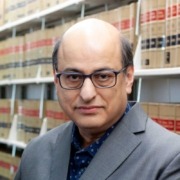
By Cyrus D. Mehta and Jessica Paszko*
Noncitizen professors or researchers can more easily seek to obtain permanent residence as “outstanding professors and researchers” in light of the District Court of Nebraska’s recent decision in Scripps v. Jaddou.
Pursuant to INA § 203(b)(1), noncitizens may be eligible for permanent residency under the employment-based first preference (EB-1B) category if:
- they are recognized internationally as outstanding in a specific academic area,
- they have at least 3 years of experience in teaching or research in the academic area, and
- they seek to enter the United States-
- for a tenured position (or tenure-track position) within a university or institution of higher education to teach in the academic area,
- for a comparable position with a university or institution of higher education to conduct research in the area, or
- for a comparable position to conduct research in the area with a department, division, or institute of a private employer, if the department, division, or institute employs at least 3 persons full-time in research activities and has achieved documented accomplishments in an academic field.
While the statute nor the regulations define what it means to be “recognized internationally as outstanding in a specific academic area,” the applicable regulation at 8 C.F.R. § 204.5(i)(3)(i)–(ii) states:
- Evidence that the professor or researcher is recognized internationally as outstanding in the academic field specified in the petition. Such evidence shall consist of at least two of the following:
- Documentation of the alien’s receipt of major prizes or awards for outstanding achievement in the academic field;
- Documentation of the alien’s membership in associations in the academic field which require outstanding achievements of their members;
- Published material in professional publications written by others about the alien’s work in the academic field. Such material shall include the title, date, and author of the material, and any necessary translation;
- Evidence of the alien’s participation, either individually or on a panel, as the judge of the work of others in the same or an allied academic field;
- Evidence of the alien’s original scientific or scholarly research contributions to the academic field; or
- Evidence of the alien’s authorship of scholarly books or articles (in scholarly journals with international circulation) in the academic field;
- If the standards in paragraph (i)(3)(i) of this section do not readily apply, the petitioner may submit comparable evidence to establish the beneficiary’s eligibility.
However, the petitioner will not be victorious just by way of establishing that the prospective beneficiary satisfies at least two of the above regulatory criteria by a preponderance of the evidence. Once United States Citizenship and Immigration Services (USCIS) determines that two regulatory criteria have been met, it conducts a second layer of review – the “final merits determination” pursuant to Kazarian v. USCIS (see our blog) – to determine whether the beneficiary may be classified as an outstanding professor or researcher.
On December 12, 2023, the District Court of Nebraska rendered its decision in the case of Scripps v. Jaddou. At issue was whether the USCIS properly denied the Scripps’ petition by finding the prospective beneficiary, Julia Lum, did not qualify for an EB-1B visa even though she satisfied the regulatory criteria. Scripps College challenged the USCIS’s denial under the Administrative Procedure Act (APA) in the District Court of Nebraska. A decision by the USCIS will be upheld if challenged in federal district court under the APA unless it is “arbitrary, capricious, an abuse of discretion, or otherwise not in accordance with the law” (5 U.S.C. § 706(2)(A)). An agency decision is arbitrary and capricious if, for instance, “the agency acted outside the bounds of reasoned decision making” or provided an explanation “that runs counter to the evidence.”
The USCIS found that Dr. Lum satisfied three of the regulatory criteria, namely (1) she participated as the judge of the work of others in the same or allied academic field of art history; (2) she made original contributions or scholarly research contributions to art history; and (3) she authored scholarly books or articles in scholarly journals with international circulation in art history. However, it denied EB-1B classification because the evidence under the “final merits determination” did not show that her work impacted the field of art history to an extent which shows “that she is internationally recognized as an outstanding researcher.” According to the USCIS, the record showed that Dr. Lum met the plain language of three regulatory criteria, but it did not show that “she is strong in any of them.” The Court pointed out that throughout the final merits analysis, “USCIS repeatedly stated that the evidence presented by Scripps was insufficient to establish Dr. Lum is recognized internationally as outstanding; however, it never stated what was required to establish international recognition as an outstanding professor or researcher.” For instance, in its final merits determination analysis, the USCIS focused on the number of times Dr. Lum’s work had been cited and found that the evidence failed to demonstrate that scholars referenced Dr. Lum’s work ‘to an extent that would establish international recognition as outstanding in the field.’
Perhaps, the USCIS did not find compelling the six citations that Dr. Lum’s publication had garnered. However, the expert letters submitted by Scripps demonstrated that Dr. Lum’s work was published in prestigious journals in art history and that six citations in a ‘low citation field’ was a high number of citations in the field. This evidence clearly contradicts the USCIS Policy Manual’s own example of a situation where such evidence should sway the adjudicating officer’s totality analysis as “evidence demonstrating that the total rate of citations to the beneficiary’s body of published work is high relative to others in the field . . . may indicate a beneficiary’s high overall standing for the purpose of demonstrating that the beneficiary enjoys international recognition as outstanding.” This excerpt from the Policy Manual was cited by the Court at the outset of its decision in Scripps.
Ultimately, the Court found that the “unexplained internal inconsistencies” reflect that the USCIS failed to ‘articulate a satisfactory explanation for its action including a rational connection between the facts and the choice made.’ In addition to the internal inconsistent findings, the Court concluded, as did the Kazarian court, that USCIS imposed “novel evidentiary requirements.” The USCIS imposed such novel evidentiary requirements when it found that Scripps failed to show that Dr. Lum’s ‘work is being taught at more institutions than any other scholar’s works’ and on that basis concluded that this did not demonstrate Dr. Lum’s ‘impact on the academic field exceeds that of any other researcher.’ The USCIS further imposed novel evidentiary requirements when it acknowledged that Dr. Lum received funding in support of her research but found that the record did not support that Dr. Lum received funding in excess of other researchers or that she received her funding in recognition of her outstanding achievements. The Court determined that these findings were not supported by the record, and that the regulations and USCIS policy manual do not require the petitioner to show the beneficiary’s contributions must exceed that of other researchers or professors in the field. The imposition of such novel evidentiary requirements rendered the USCIS’s denial of Scripp’s petition arbitrary and capricious.
Upon applying the evidence in the record to the regulatory criteria and the guidelines in the policy manual, the Court concluded that Scripps established by a preponderance of the evidence that Dr. Lum qualified for international recognition as an outstanding professor or researcher in the field of art history, and reversed the USCIS’s denial. The Court was compelled by the nine letters that were submitted from prominent experts in the field of art history, who spanned three continents, and uniformly agreed that Dr. Lum is internationally recognized as an outstanding researcher in her field. The experts provided evidence of Dr. Lum’s original contributions, citations relative to the field of art history, high level of grant funds relative to others in the field, the importance of Dr. Lum’s original contributions and publications in prestigious journals, invitations (solicited and unsolicited) to present and attend conferences, and reliance on Dr. Lum’s work to teach students at the world’s highest ranked institutions.
This decision teaches how we should attack the final merits determination by demonstrating that the USCIS’s finding under the second step is inconsistent with its finding under the first step, and that the USCIS cannot impose novel evidentiary requirements under the second step. However, if cases like this are litigated in the 9th Circuit or the 5th Circuit, the district court will be bound by the second step analysis under Kazarian v. USCIS and Amin v. Mayorkas (see our blog), respectively. As mentioned above, Kazarian which was decided in the 9th Circuit, has been interpreted to require a second step analysis in EB-1 petitions. The 5th Circuit grounded the final merits determination even deeper into the EB-1 framework in Amin. While the USCIS Policy Manual has adopted Kazarian’s final merits determination and requires officers adjudicating EB-1 petitions to conduct this second step analysis, district courts outside the jurisdiction of the 9th or 5th Circuits that review USCIS decisions are not bound by Kazarian or Amin or the USCIS Policy Manual. Such courts are only bound by precedent issued in its jurisdiction, statutes, or regulations, and therefore, need only consider the governing statutes, which in case of EB-1As (8 C.F.R. §204.5(h)) and EB-1Bs (8 C.F.R. §204.5(i)) are silent as to a second-step, final merits determination. Of course, a district court can conduct its review through the lens of the USCIS Policy Manual if it is persuaded by it, as was the case in Amin. A court can also be swayed by the second step analysis if it was persuaded by the holding in Kazarian as was the case in Rijal v. USCIS, Noroozi and Assadi v. Napolitano, Eguchi v. Kelly, Visinscaia v. Beers, and a number of other unpublished decisions which we discussed here. As was evidenced in all of these decisions, federal courts seem to be following the second step analysis even outside the 5th and 9th Circuits.
Most recently, in Amin, the self-petitioner challenged the Policy Manual on the ground that it was not in accordance with the law because it conflicts with the regulation. Amin argued that once an EB-1A “applicant meets three of the ten regulatory criteria, the regulation shifts the burden to the government to explain why the applicant has not demonstrated extraordinary ability.” Indeed, this burden shifting approach was the standard pre-Kazarian pursuant to Buletini v. INS. The 5th Circuit disagreed with Amin and found that the USCIS’s application of the second step was consistent with the statute and regulation, clinging onto the regulation’s label “Initial evidence”, and the regulation’s requirement that applicants must submit evidence of “at least three criteria”, to conclude that this “word choice contemplates another step beyond submitting the enumerated evidence: if satisfying three criteria were enough, why would the agency invite proof of more?”
In comparison, it does not seem that the petitioner in Scripps challenged the USICS Policy Manual like Amin had, and thus, the Court did not have to render a decision as to the second step’s consistency with the statute and regulation. Still, the Court noted at the outset, by citing to Kazarian, that a “two-step review of the evidence submitted with an I-140 petition is required in determining whether a foreign national may be classified as an outstanding professor or researcher.” The Court also provided examples from the Policy Manual with respect to what officers may consider in the final merits determination. Indeed, the examples that it chose to extract from the Policy Manual were directly applicable to the evidence that was provided by Scripps, and it appears that these excerpts from the Policy Manual convinced the Court that the USCIS made internally inconsistent findings because the kind of evidence that these excerpted examples contemplated had been provided by Scripps. We noted one such inconsistency, with respect to the low number of citations, above.
The Scripps Court’s close adherence to the USCIS Policy Manual also contributed to its rejection of the inherent subjectivity of the final merits determination. One such example of the second step’s vicious subjectivity was evident in Noroozi and Assadi v. Napolitano where the self-petitioner did not meet at least three regulatory criteria, which could have ended the analysis, but the Southern District of New York also discussed how the self-petitioner would not have merited a favorable judgment under the second step because he ranked 248th in the world in table tennis and finished in 65th place in table tennis in the 2008 Olympics. According to the Southern District, these rankings would have obliged the USCIS to hypothetically grant EB-1 visas to the 283 higher ranked table tennis players and to the 283 higher ranked players in other sports, assuming they were noncitizens, as well as to the 64 table tennis players who outperformed the self-petitioner in the 2008 Olympics. The Southern District’s findings clearly invoked subjectivity as the EB-1 was never intended only for the number one player in a sporting field. This decision was issued prior to the publication of the USCIS Policy Manual. At the time Noroozi and Assadi v. Napolitano was decided in 2012, a USCIS Policy Memo titled “Evaluation of Evidence Submitted with Certain Form I-140 Petitions; Revisions to the Adjudicator’s Field Manual (AFM) Chapter 22, AFM Update AD11-14” was in effect as of December 22, 2010 and stated:
If the USCIS officer determines that the petitioner has failed to demonstrate these requirements, the USCIS officer should not merely make general assertions regarding this failure. Rather, the USCIS officer must articulate the specific reasons as to why the USCIS officer concludes that the petitioner, by a preponderance of the evidence, has not demonstrated that the alien is an alien of extraordinary ability under section 203(b)(1)(A) of the INA.
The current USCIS Policy Manual similarly attempts to restrain the second step’s subjectivity by stating:
When requesting additional evidence or denying a petition, if the officer determines that the petitioner has failed to demonstrate eligibility, the officer should not merely make general assertions regarding this failure. Rather, the officer must articulate the specific reasons as to why the officer concludes that the petitioner, by a preponderance of the evidence, has not demonstrated that the beneficiary is an outstanding professor or researcher.
This excerpt was also cited by the Scripps Court at the outset of its decision. Later, in its discussion of the USCIS’s final merits analysis with respect to the evidence Scripps had submitted, the Court highlighted that “[t]hroughout the final merits analysis, the USCIS repeatedly stated the evidence presented by Scripps was insufficient to establish Dr. Lum is recognized internationally as outstanding, however, it never stated what was required to establish international recognition as an outstanding professor or researcher.” It is clear to us that in doing so, the USCIS clearly failed to “articulate specific reasons” as instructed by the Policy Manual and instead made “general assertions” which the Policy Manual admonished. Despite the similarities in the December 22, 2010 USCIS Policy Memo and the USCIS Policy Manual, the Scripps Court still rejected the second step’s subjectivity, unlike the Noroozi and Assadi court. The discrepancy can perhaps be explained by the Scripps Court’s close reading of the USCIS Policy Manual which ultimately contributed to its rejection of the imposition of evidentiary requirements that were outside the parameters of the Policy Manual. Neither the USCIS Policy Manual nor the 2010 USCIS Policy Memo state that one has to be an individual of certain standing in order to qualify for the EB-1. For the Noroozi and Assadi court to rule against the self-petitioner in a hypothetical final merits determination because he was not a top player, despite making it to the Olympics, was clearly a result of the court’s unbridled subjectivity. The Noroozi and Assadi court likely also would have agreed with the USCIS’s denial of Dr. Lum’s EB-1B classification because Scripps failed to show that her work was ‘being taught at more institutions than any other scholar’s works’ or that she did not receive funding in excess of other researchers. However, as the Scripps court made clear, the regulations and USCIS Policy Manual do not require the petitioner to show that the beneficiary’s contributions must exceed that of other researchers or professors in the field, and by doing so, curtailed the rampant subjectivity that has plagued EB-1 cases post-Kazarian.
Scripps v. Jaddou adds a positive rung to the growing ladder of final-merits-EB-1-cases which currently stands in opposition to prospective beneficiaries who, despite satisfying the regulatory criteria, end up falling short of their desired classification due to the curse of Kazarian. Although Scripps did not eviscerate the final merits determination analysis, it still paves the way for petitioners to argue that USCIS cannot and should not, under the cover of the second step final merits determination, be allowed to introduce new requirements outside the parameters of the regulatory criteria or reverse its prior acceptance of evidence under the regulatory criteria.
*Jessica Paszko is an Associate at Cyrus D. Mehta & Partners PLLC.