


Deportation Judges
By Prof. Stacy Caplow, Brooklyn Law School[1]
Do you want to be a judge? Hurry up to apply—the deadline is July 17, 2026. Look no further than this ad which says:
“Help write the next chapter of America. Apply today to become a deportation judge. Define America for Generations.”[2]
The Trump administration is remaking the Immigration Court in its own image springing into a hiring frenzy following the rapid-fire depletion of more than 100 experienced Immigration Judges.[3] Between February 2025 and May 2026, this aggressive recruitment effort netted 134 new full time and 22 temporary IJs.[4] The general qualifications of the individuals who heeded this call surprised no one: Their numbers overwhelmingly included immigration enforcement lawyers, prior prosecutors and veteran or active military officers. A mere three new IJs had any obvious experience representing immigrants, and even those career interludes were brief and in the past.
Another troubling revelation was how many individuals appointed to this stressful, high volume, complex job lacked any apparent prior knowledge of or experience in immigration law. In addition to this minimal level of relevant substantive experience, a significant number had received JD degrees within the past 15 years and a few even had earned that degree in less that the supposedly requisite seven years. Adding insult to injury, the EOIR reduced their training from six weeks[5] so that some new judges were presiding over merits hearings only a few weeks after being sworn in.[6]
These preferences should surprise no one who has paid attention to the goals of this administration to reduce, if not eliminate, grants of relief such as asylum or cancellation of removal, to reduce decades of due process guarantees by ordering removal without an evidentiary hearing, and to deter judicial independence with the threat of firing. By all reports, the restaffing of the immigration court has achieved these goals. resulted in higher rates of denials in asylum cases. Over the last twelve months, the Immigration Court asylum grant rate has plummeted.[7]
The posted job qualifications are very broad yet do not prioritize or even specify any prior knowledge of or experience in immigration law and practice in addition to the minimum requirements of a law degree and law license.[8] The remaining preferred prior experience includes litigating criminal cases, including in the military, or conducting administrative hearings. It is not unexpected, therefore, that a great number of the new IJs have government enforcement, military, and/or prosecution backgrounds. Many have a combination of some or all of these credentials.
Despite this rapid-fire hiring binge, the credentials of these newly appointed IJs actually hew pretty closely those IJs appointed during the first Trump administration. Once again, large numbers of IJs are drawn from the ranks of government employees. They come from enforcement offices, particularly ICE Office of the Principal Legal Advisor, as well as USCIS and EOIR. Similar numbers of IJs have military and prosecution backgrounds, or both. The number of new judges with past judicial experience is comparable also.
| Credential | 2017-2020[9] | 2025-2026[10] |
|
Gov’t Immigration Enforcement Background
|
46% |
42% |
|
Military Background
|
22% |
31% |
|
Prosecution Background
|
51% |
40.2% |
|
Judicial Background
|
17% |
13.4% |
Government Employment Background
Former Government-Side Immigration Lawyers
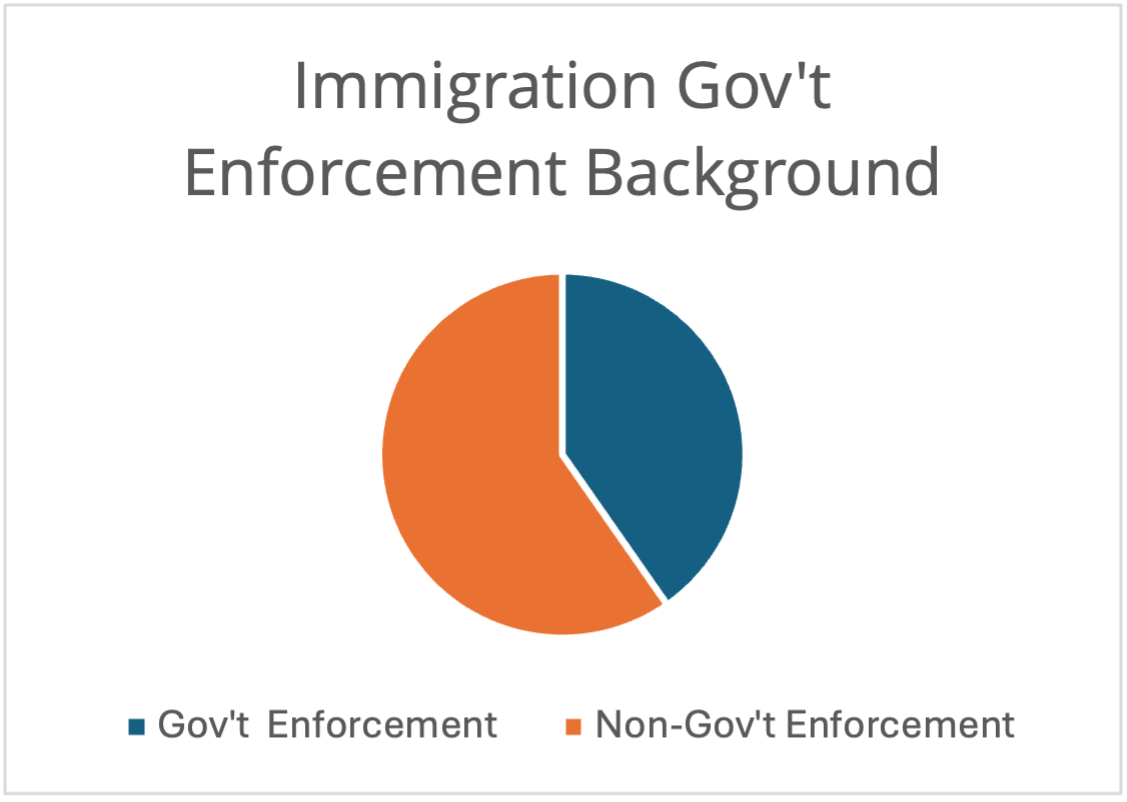
Immigration Gov’t Enforcement Background
Forty-two percent, 54/134, new IJs have at one time practiced with the ICE’s Office of the Principal Legal Advisor (OPLA), the Immigration Court prosecutors, worked for USCIS as asylum officers or legal counsel or have been lawyers at EOIR. This number closely tracks the forty-six percent of the IJs appointed during the first Trump administration who also had this background. These credentials are not prima facie objectionable since this background reflects a deeper understanding of immigration law and court practice, but a one-sided career may produce judgment distortion and possibly affect objectivity. In addition, the many edicts issued by EOIR that subvert transparent fact-finding processes of immigration court hearings by granting pretermission with a hearing, [11] restricting online access to observers,[12] creating “mega/mass master calendar hearings[13] are designed to diminish the individual discretion and decisional autonomy of IJs. Given past loyalties to these enforcement institutions, and the chilling track record of terminations without any stated cause, IJs, especially the new appointees, likely rightly fear for their jobs if they deviate from these dictates. Independence is undermined by both the selection process and the oversight of EOIR.
Military and Prosecution Background
Again, these credentials have always been well represented on the Immigration Court bench. Often the IJ has both credentials on their resume. Many of the former government lawyers also combine past military and prosecutorial backgrounds.
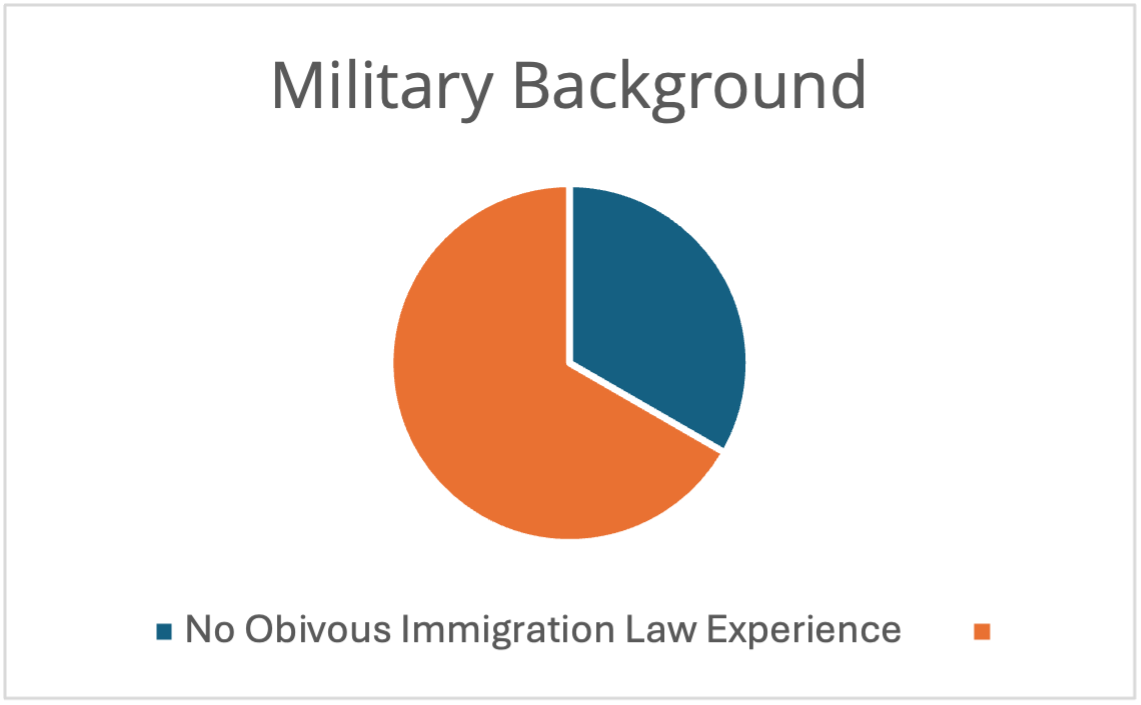
Thirty-one percent, 42/134, of the new IJs have been or are currently service members. This number represent a significant increase likely due to the controversial reassignment of JAG lawyers to the immigration bench.[14]
Military Background
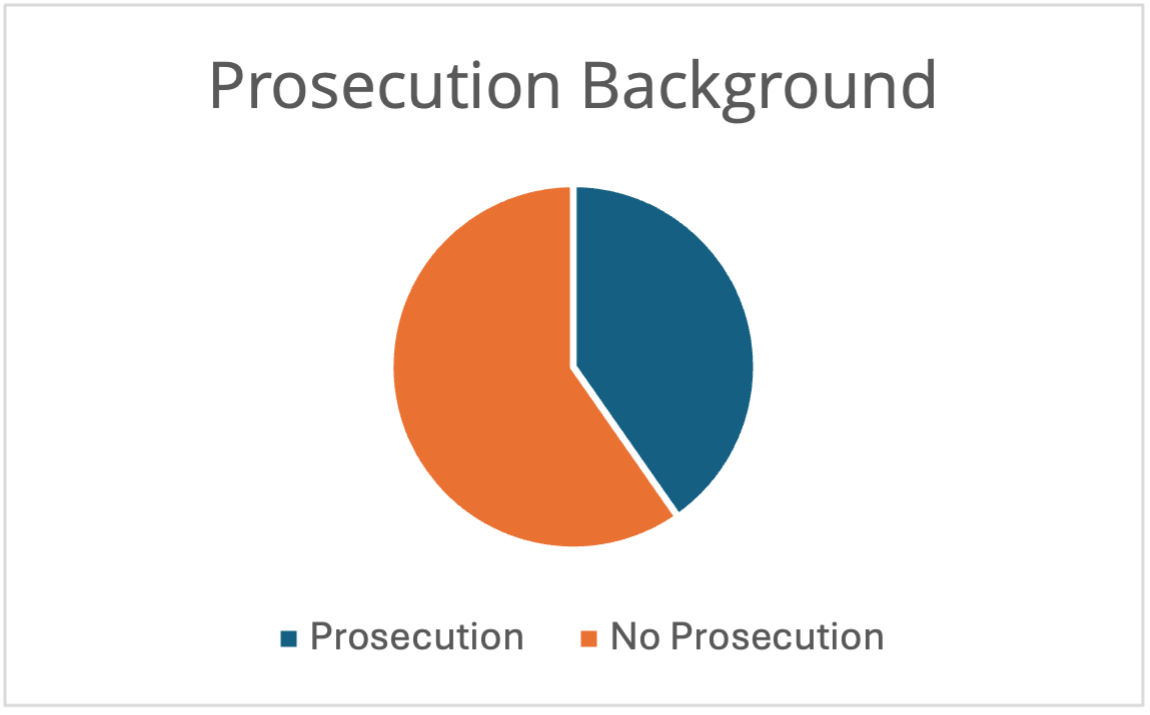
Former prosecutors also proliferate the new ranks of IJs. Forty-two percent, 54/134 have been former prosecutors in either state or federal offices. This is likely an undercount since some EOIR biographies refer to general positions with a “State’s Attorney” or US Attorney’s Office and do not specify civil or criminal divisions. Unless this distinction was clear, that individual was not counted as a former prosecutor.
Prosecution Background
Government lawyer backgrounds do not conclusively create anti-immigrant bias, but for someone who has worked almost exclusively in an authoritarian workplace routinely opposing various forms of relief, beholden to orders and policies that might undercut or eschew discretion and open-mindedness, and be subject to discipline for perceived deviations, judicial independence may be difficult to imagine or achieve.
Indeed, the very title Deportation Judge and the language used in the job announcement encourage a perception of the position as enforcement and anti-immigrant. For example, the ad describes the job as “Ensur[ing] adherence to the law; combat[ing] fraud and ensur[ing] those seeking to exploit vulnerabilities in our immigration system are not successful,” implying that the system is riddled with bad actors who need to be ferreted out and deported. There is no message of the benefits or humanitarian role of the Department of Homeland Security other that a reference to deciding “who gets to stay.”
Judicial Experience
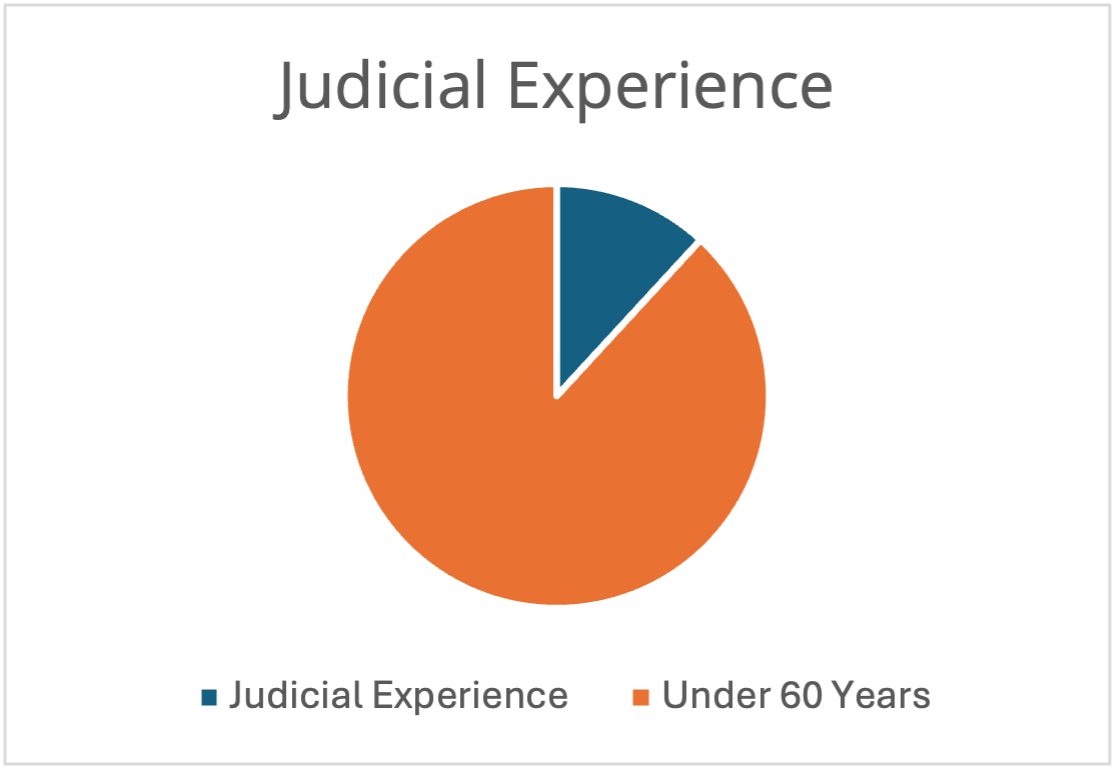
Prior judicial experience is unquestionably a plus for any adjudication setting, even the unique immigration court.[15] Slightly more than 13% (18/134) of the new IJa worked either full or part-time in local administrative courts although none had any immigration focus and often were tribunals for state agencies dealing with commercial, family or health matters. A few had been judicial law clerks. But as is so often pointed out, the law, especially in these unstable times, is complex, the decisions in immigration court are life-altering and almost always require an exercise of discretion.[16] The evaluation and application of discretionary factors is a sensitive and quite subjective process that relies on well-developed tools of evaluation and judgment in often highly fact-sensitive cases. While some prior adjudicators may have developed solid judgment in their respective realms, immigration, with its potentially drastic consequences, poses different. Balancing. Judicial temperament and administrative skills may not be sufficient to assure fair and just outcomes.
Judicial Experience
Prior Immigration Law/Practice Experience
Typically, many IJs come to the bench with immigration law practice experience, most often as ICE Trial Attorneys. As such, they are, or should be, familiar with the proceedings and the applicable legal principles. Nevertheless, more than 50% of new IJs (67/134) lack any obvious, perceivable immigration law background. Again, this complete lack of relevant knowledge of this complex legal regime, combined with hasty, shallow training in substantive law, contradicts the usual qualifications for a judge in a specialized practice area. Thrown into presiding over full hearings or applying the swiftly evolving new case law from the BIA as well as the policy dictates of EOIR, these judges have a recklessly steep learning curve. As they are learning, they have to decide life-or-death claims.
Since these newly appointed judges are refilling the ranks of more, and in many cases much more, experienced IJs, their appointments are not equivalencies for the judges they are replacing.
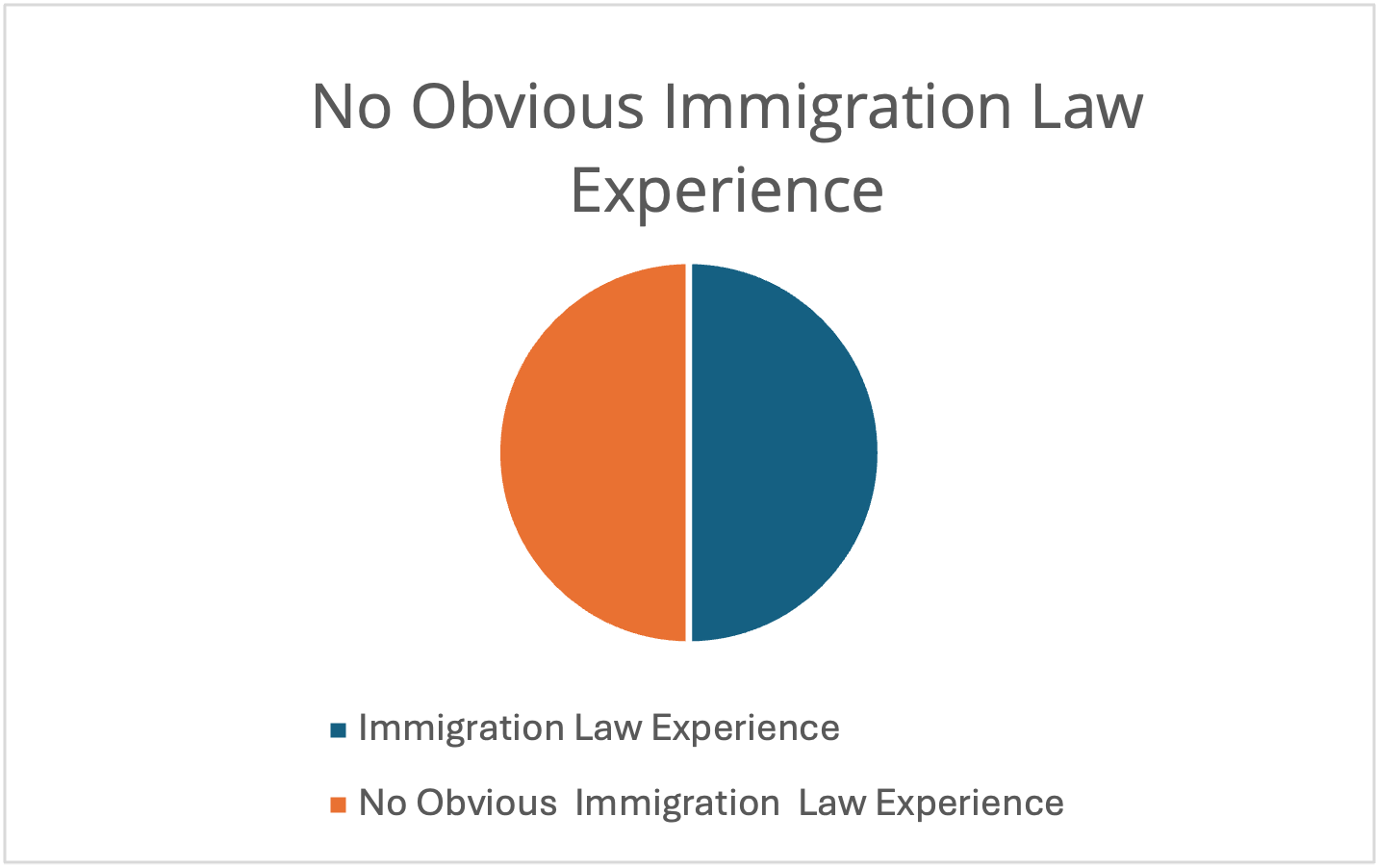
No Obvious Immigration Law Experience
Age and General Legal Experience
The 2026 appointments present a “goldilocks” problem since many judges are very early in their careers while many are very late in their careers. Considering the pressures of the immigration bench, the extent and depth of knowledge needed, and the maturity and temperament to run a courtroom with patience, dignity and respect, this job requires experience.
The stated amount of post-licensing experience is frighteningly undemanding: seven years of any post-bar admission experience.[17] Although most of the newly named IJs do have more than the bare minimum years of experience, 35 of them have been admitted for less than 15 years. It is difficult to imagine that the 35 individuals who graduated from law school with 15 years or less before taking the bench possess the maturity and disposition necessary for this challenging job. Six of the 35 new IJs graduated after 2016 and one the graduated only in 2018.
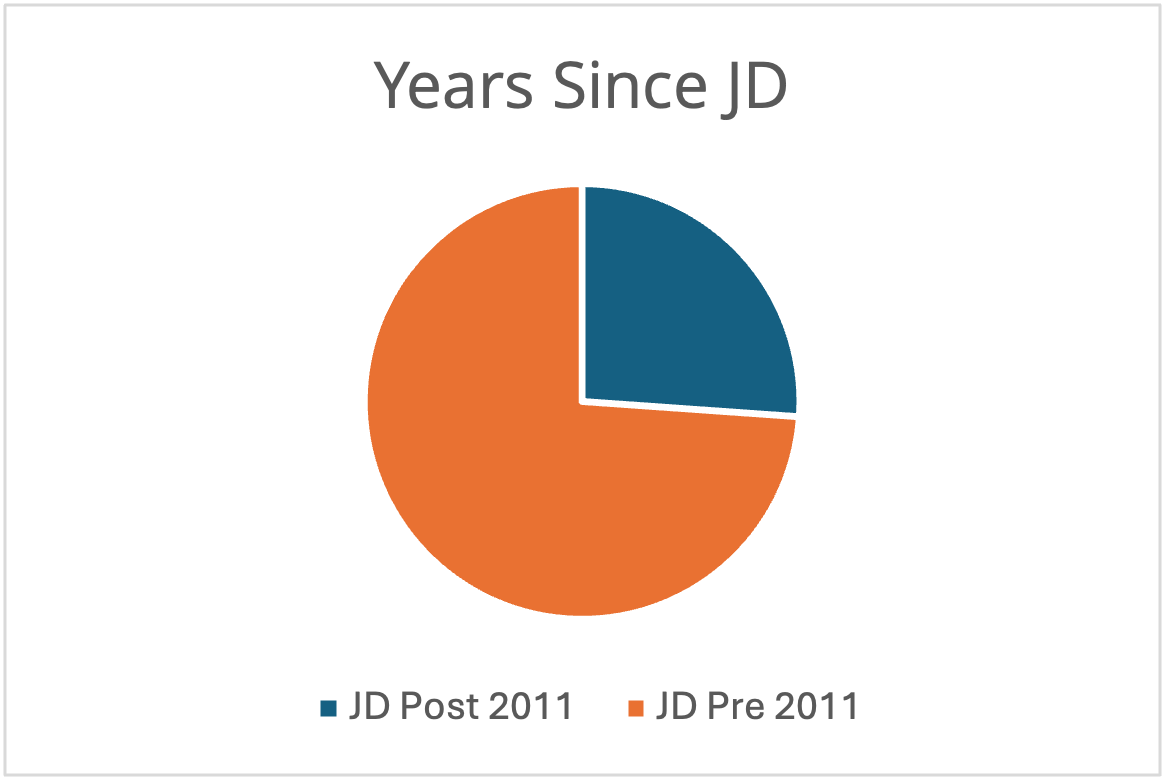
Years Since JD
At the other end of the spectrum are the considerable number of new IJs who are older than 60. Assuming they received their undergraduate degrees at age 22 in the 1970s or 1980s, 25 judges are in their 60s or even 70s. Most jurisdictions require judges to retire or take senior status by age 70 although there does not seem to be a mandatory retirement age in EOIR. While these new IJs have had longer, and in some cases more responsible, careers, none of them specialized in immigration law. It is difficult to imagine that they will serve for many years on the immigration bench. Given the time necessary to reach full capacity and mastery, investing in senior IJs may not be an efficient use of resources.
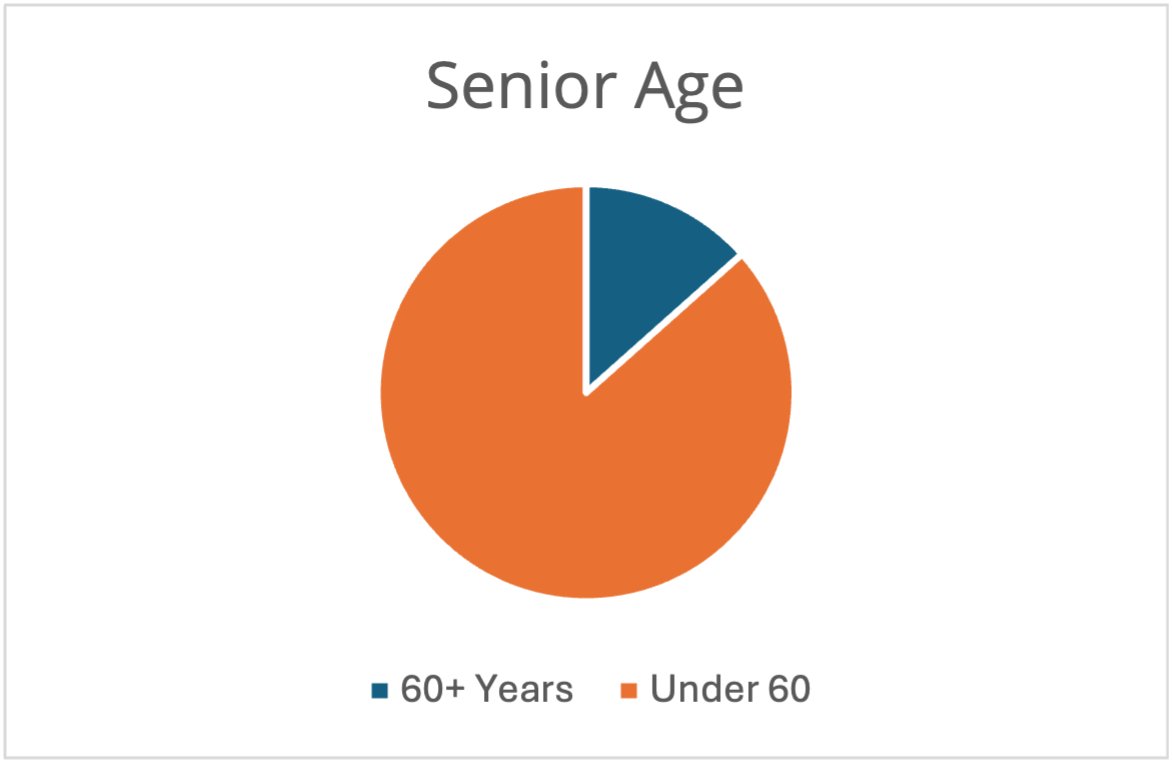
Senior Age
Immigrant Advocacy Backgrounds
Hiring
One of the key differences between the Trump 1.0 and 2.0 appointments and those IJs appointed by Biden is the greater diversity of the Biden judges. Early in 2021, the number of IJs appointed by Biden who had a background as immigrant advocates jumped noticeably. In the first year of his administration, 19.4% of Biden’s new IJs had worked for most, if not all, of their careers at nonprofits or private immigration firms. This contrasts to the 10-11 appointed during the full four years of Trump 1.0. Only three of the biographies of the 2026 appointed noted any immigrant advocacy work experience, and even that occurred during the early years of their careers.
Firing
The Biden administration explicitly valued diversity and inclusion by inviting applicants “from all backgrounds to join our corps of dedicated adjudicators.”[18] The inescapable impression created by the 100+ purge was that EOIR targeted Biden appointees since all but 15 of them had appointed after 2021. They also consisted of more liberal IJs with higher grant rates many of whom were women, came from identifiable ethnic backgrounds, had immigrant advocacy careers, and/or were recognized as Democrats. Most were summarily fired without explanation. Others were fired after issuing decisions that the administration disliked.[19]
Some terminated IJs are fighting back. For example, in Irma Pérez v. Todd Blanche, et al.,[20] the complaint alleges sex and age discrimination as well as a civil rights violation. Her complaint identifies by name 37 women judges who were fired, seven judges with Spanish surnames, and 4 judges with South Asian or Middle Eastern surnames. Other discrimination lawsuits have been filed in the District of Columbia,[21] Massachusetts,[22] Illinois,[23] and California[24] advancing similar allegations and facts. An earlier lawsuit challenging the terminations was unsuccessful before the Merit Systems Protection Board so the IJs have turned to the federal courts.[25]
Conclusion
Immigration Court watchers do not need to be told that the bench has been radically transformed over the past 18 months. Of course, it is dangerous to over-generalize but it is easy to see that the demographics tilt inescapably in favor of people whose backgrounds and experiences imply a sympathy with this administration’s goals. The job description attracts people with identifiable political and ideological beliefs. Diversity and inclusion are not hiring goals. Once appointed, the new judges are going along with the program: terminating applications thus opening the doors for detention and removal; ordering removals to third countries pursuant to Asylum Cooperative Agreements; denying relief in record numbers. Judges whose decisions defy the administration lose their jobs.
Immigration Court has always been a treacherous place to navigate especially for the unrepresented. Today, its hallways and courtrooms are locations of both legal and physical risk, not only to the individuals appearing there but to lawyers and court observers.[26] Under the thumb of overbearing ideologues, IJs can no longer be counted on to exercise independent, unbiased judgment or to protect the rights of immigrants.
[1] Guest author Prof Stacy Caplow is a leader in the field of clinical legal education. For more than ten years, Prof. Caplow was the law school’s first dean overseeing all aspects of clinical and experiential education. Read her full biography at https://www.brooklaw.edu/contact-us/caplow-stacy/
[2] See https://join.justice.gov/.
[3] The National Association of Immigration Judges (NAIJ) has been collecting information about fired judges. This anonymous list notes that 103 judges lost their jobs. The list does not separate IJs who may have retired but all but 15 were appointed after 2021 so it’s doubtful that any of them left voluntarily, List on file with author.
[4] EOIR Notice May 21, 2026: 77 new judges, https://www.justice.gov/opa/media/1441861/dl; April 8, 2026: 15 new judges, https://www.justice.gov/eoir/media/1435381/dl?inline ; March 11, 2026: 42 new judges, https://www.justice.gov/eoir/media/1430876/dl?inline. In order to facilitate hiring temporary IJs, EOIR promulgated new regulations at 8 CFR §1003.10 that eliminated the level of experience for this position. Formerly, it was restricted to individuals who had either been immigration adjudicators or experienced government attorneys. The new rule mirrors the more lenient requirements for full IJs but limits the term of service. 90 F.R. 41883, Aug. 28, 2025, https://www.govinfo.gov/content/pkg/FR-2025-08-28/pdf/2025-16573.pdf.
[5] Fact Sheet, Executive Office for Immigration Review Immigration Judge Training, https://www.justice.gov/eoir/page/file/1513996/dl?inline
[6] Celine Castronuovo, Trump Immigration Judges Pushed to Deny Asylum in Swift Training, Bloomberg Law, Feb. 4, 2026, https://news.bloomberglaw.com/us-law-week/trump-immigration-judges-pushed-to-deny-asylum-in-swift-training.
[7] Austin Kocher, The Asylum Denial Machine, June 19, 2025, https://austinkocher.substack.com/p/the-asylum-denial-machine ; TRAC Immigration, Immigration Court Asylum Grant Rates Cut in Half, https://tracreports.org/reports/766/ (During August 2025, only 19.2 percent of asylum seekers were granted asylum). A year earlier during August 2024, the grant rate was 38.2 percent).
[8] Applicants must possess qualifying post-licensure litigation or adjudication experience.
Qualifying trial experience includes experience litigating cases in which a complaint was filed with a court or administrative agency, or a charging document (e.g., indictment, notice of violation, or information) was issued by a court, administrative entity, grand jury, or appropriate military authority. Qualifying experience conducting administrative hearings or adjudicating administrative cases includes relevant experience handling cases in which a formal procedure was initiated by a governmental administrative body.
https://www.usajobs.gov/job/853385500
[9] The percentages for the first Trump administration are drawn from Stacy Caplow, The Sinking Immigration Court: Change Course, Save the Ship, 4 A.I.L.A. L.J, 39, 46-50 (2022). In turn, these numbers derive from the various EOIR announcement of new appointments during that time period.
[10] The percentages are drawn from the EOIR Notices, supra n. 3.
[11] Pretermission of Legally Insufficient Applications for Asylum, PM 25-28, Effective: April 11, 2025
[12] Fact Sheet, Observing Immigration Court Hearings, Nov. 2025.
[13] Trump Administration Short Circuits Due Process with New Mass Hearings for Unrepresented Immigrants, Nat’l Immig. Justice Ctr., May 29, 2026.
[14] Memorandum Opinion for the General Counsel Department Of War, Detailing Attorneys to the Department of Justice to Serve as Immigration Judges and Special Assistant United States Attorneys, Oct. 23, 2025 (“The Department of War may detail attorneys to serve as immigration judges on a reimbursable basis.”); Ximena Bustillo , Military lawyers called up to relieve a shortfall in immigration judges, NPR, Sept. 2, 2025; N.Y.C. Bar Ass’n, Report By The Immigration & Nationality Law Committee and the Rule Of Law Task Force Condemning the Use of Military Lawyers as Temporary Immigration Judges, Jan 15, 2026.
[15] See supra note 6.
[16] The famous describes immigration court a deciding “death penalty cases in a traffic court setting.” IJ Dana Marks provided this unforgettable description on an episode of Last Week with John Oliver.
[17] EOIR, How to Become an Immigration Judge, https://www.justice.gov/eoir/how-become-immigration-judge.
[18] Notice, EOIR Announces 24 New Immigration Judges, Oct. 27, 2021, https://www.justice.gov/d9/pages/attachments/2023/05/30/eoir_announces_24_new_immigration_judges_10272021.pdf. In this small but representative batch, 50% of the new IJs had worked at some point as immigrant advocates either for NGOs or in private practice.
[19] Hamed Aleaziz, Nicholas Nehamas and Steven Rich , Judges Fired After Blocking Deportations of Pro-Palestinian Students, NY Times, Apr. 11, 2026; Joshua Goodman, Military Lawyerr Swiftly Fired From Immigration Bench After Defying Trump Deportation Push, AP, Dec. 19, 2025.
[20] 2:26-cv-06173 (C.D. Cal , 2026), https://www.law360.com/articles/2487026?sidebar=true. See also, Celine Castronuovo and Megan Crepeau, Fired Immigration Judges Test Trump’s Executive Power in Suits, Bloomberg News, June 10, 2026, https://news.bloomberglaw.com/us-law-week/fired-immigration-judges-test-trumps-executive-power-in-suits ;
[21] Nemer v. Bondi, 1:25-cv-04170, (D.D.C.); Former Immigration Judge files lawsuit accusing Trump administration of bias in her firing, NBC News, Dec. 2, 2025
[22] Simon Rios, Fired Mass. immigration judge sues Trump administration to get his job back, WBUR, May 18, 2026, https://www.wbur.org/news/2026/05/18/massachusetts-george-pappas-chelmsford-boston-judge-sues-trump.
[23] Espinoza v. Blanche, 1:26-cv-05157 (N.D. Ill., May 5, 2026).
[24] Lilien v. Blanche, No. 3:26-cv-03965 (N.D. Cal.); Chamberlin v. Blanche, 3:26-cv-04390 (May 12, 2026); Luz Pena, Fired Bay Area Immigration Judge sues DOJ alleging discrimination over gender, age and political views, May 7, 2026, https://abc7news.com/post/fired-bay-area-immigration-judge-sues-doj-alleging-discrimination-gender-age-political-views/19054420/.
[25]Jackler and Jarosh v. Dep’t of Justice, MSPB Docket No. DA-0752-25-0330-I-1, Mar. 20, 2026
[26] Victoria Bekiemkis, Brad Lander found not guilty of blocking elevator at New York ICE facility, The Guardian, June 11, 2026, https://www.theguardian.com/us-news/2026/jun/11/brad-lander-not-guilty-blocking-elevator-new-york-ice.





Leave a Reply
Want to join the discussion?Feel free to contribute!